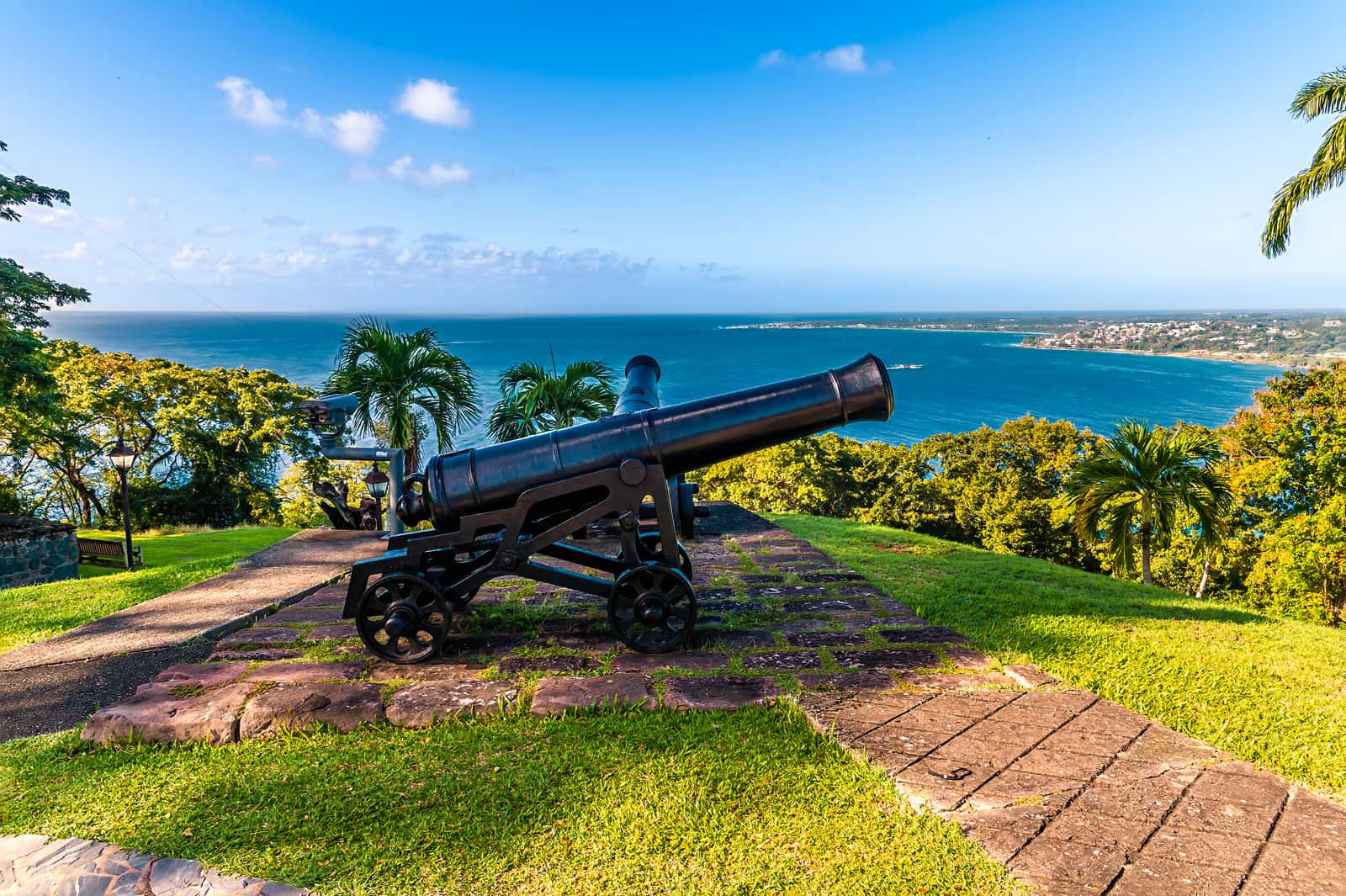
In the fort's former Officers' Mess the Tobago Museum now shows finds left by the island's first inhabitants. Outside stand the walls of a fort the British began and the French enlarged. It had three names before it got the one it has now.
The whole island went the same way. The Dutch, Courlanders, French and British fought over Tobago, traded it and gave it up again. Sources count the changes of hands differently, but all of them arrive at about 30 or more. Then came sugar and slavery, and in the end an assembly of its own, which still sets Tobago apart from Trinidad.
- Columbus sights the island
- 149814 August, without landing
- Changes of hands
- about 30 to 33depending on the count, up to 1814
- Enslaved people
- 18,153peak in 1807
- Emancipation
- 1 August 1838after apprenticeship
- Tobago House of Assembly
- since 1980in its present form
Before Columbus, and the first sighting
People lived on Tobago long before the Europeans. English Wikipedia names Ortoiroid groups between about 3500 and 1000 BC, and from the first century AD the Saladoid. Some of what they left behind is in the museum at Fort King George.
On 14 August 1498 Christopher Columbus saw the island. He did not go ashore. The two Wikipedias disagree on the name he gave it: "Belaforme" in English, "Bella Forma" in German. In 1511 Spain allowed slave raids on the island.
The Dutch and the Courlanders on Great Courland Bay
The first European settlers came to the Caribbean side. In 1628 the Dutch founded the colony of Nieuw Walcheren on Great Courland Bay, with a fort near today's Plymouth.
Then came settlers from Courland. Their ruler, Duke Jacob Kettler, reigned from 1642 to 1682. English Wikipedia describes several phases of his colony on Tobago, in 1637, 1642, from 1654 to 1659 and from 1680 to 1690. German Wikipedia instead gives a claim from 1654 to 1689. On 11 December 1659 the colony passed to the Dutch.
What stayed is the name of the bay. In Plymouth a monument remembers the Courlanders, unveiled in 1976 or 1978 depending on the source. The village also has Fort James, which Rough Guides dates to 1650, making it the oldest fort on the island.
How many times did Tobago change hands?
From 1662 one change followed another. A selection, according to English Wikipedia:
- 1662: the Dutch Lampsins brothers become barons of Tobago.
- 1666: the island turns English in January and French in August.
- 1672: the British destroy the Dutch colony; in 1674 Tobago is Dutch again, in 1677 French.
- 1748: the Treaty of Aix-la-Chapelle declares the island neutral.
- 1763: the Treaty of Paris gives it to Britain.
- 1781: the French take Tobago, and in 1783 it is ceded to France.
- 1793: the British win it back; in 1802 the Peace of Amiens returns it to France, in 1803 it is British once more.
- 1814: the Treaty of Paris makes Tobago British for good.
So how many changes were there? English Wikipedia says 33, the most in Caribbean history, but gives no individual reference. German Wikipedia says "at least 33 times". The Wikipedia article on Trinidad and Tobago arrives at roughly 31, and Caribbean Beat magazine at about 30. The English Wikipedia history page itself only describes 13 to 15 individual changes. More than 30 is a matter of how you count.
You see it most clearly in Scarborough. The town has been the capital since 1769, and under the French it was called Port-Louis. According to Citizens for Conservation the British began building Fort King George in October 1777 under Governor Lord George Macartney. Rough Guides dates the start to after 1762. The French enlarged it as Fort Castries, from 1781 or from 1784 depending on the source, and later it was called Fort République and Fort Liberté. The name Fort King George first appears in 1804. Soldiers were garrisoned here until 1854.
Sugar and slavery
The plantations began around 1672. They grew large when Tobago became British in 1763. The main crop was sugar cane, and the work was done by enslaved people.
English Wikipedia gives figures. In 1790 there were 14,170 enslaved people on Tobago, in 1807 there were 18,153, more than ever before. In 1813 the count was 16,080. More than nine in ten of them worked on sugar plantations. Every one of these figures counts people who, under the colony's law, were property.
Britain abolished slavery in 1834. That did not yet make people free. First came an apprenticeship, and full emancipation followed on 1 August 1838. Emancipation Day marks that date, and every year the Tobago Heritage Festival ends with it. More on the festivals page.
After slavery: sharecropping, uprising, crown colony
From 1843 metayage spread, a form of sharecropping: workers farmed the land and handed over part of the harvest. By 1845 it was the dominant form. Then in 1846 came the Sugar Duties Act, a British customs law. The hurricane of 1847 hastened the end of sugar, and it also damaged Fort King George.
The sharecropping terms were harsh. In 1876 the Belmanna uprising broke out in Roxborough. Afterwards the island legislature gave up self-government. On 7 February 1877 an Order in Council made Tobago a British crown colony. A document from the University of the West Indies puts the end of the old House of Assembly as early as 1874.
From a ward of Trinidad to an assembly of its own
The colony did not stay on its own for long. The Trinidad and Tobago Act of 1887 prepared the union, it was proclaimed on 17 November 1888 and took effect on 1 January 1889. German Wikipedia dates the merger to 1888. In 1899 Tobago was downgraded to a ward, a district of Trinidad. The English Wikipedia article on Tobago puts this step in 1889 and so mixes up the two years.
From 1958 to 1962 both islands belonged to the West Indies Federation. On 31 August 1962 Trinidad and Tobago became independent. The country became a republic on 1 August 1976, according to English Wikipedia's articles on the country and its history. Its article on Tobago gives 31 August 1976.
In 1980 Tobago got a voice of its own back. Act No. 37, assented to on 23 September 1980, created the Tobago House of Assembly in its present form. In the first election on 24 November 1980 A.N.R. Robinson's party won eight of the twelve seats, the PNM four. The election results call Robinson's party the DAC, the Wikipedia article on him the DLP. The act was revised in 1996. Today the assembly has 15 seats, and in the election of 12 January 2026 the Tobago People's Party won all of them.
Robinson, born in 1926 and died in 2014, grew up in Castara on the north coast. He became the assembly's first chairman, helped shape the laws of 1980 and 1996, and became the third prime minister of Trinidad and Tobago. Anyone who flies into Tobago lands at the airport that bears his name.
Our tipStart in Scarborough. The Tobago Museum at Fort King George holds the finds of the first inhabitants, and from the fort you look down on the harbour and Rockly Bay. The fort is free, the museum charges a fee; ask on site about prices and opening hours. Then drive over to the Caribbean side, to Plymouth, the Courland monument and Fort James.
Frequently asked questions about Tobago's history
How many times did Tobago change hands?
It depends on how you count. English and German Wikipedia give 33 changes between 1498 and 1814, other sources 31 or about 30. Tobago became British for good with the Treaty of Paris in 1814.
When were the Courlanders in Tobago?
Settlers sent by Duke Jacob Kettler of Courland lived on Great Courland Bay near Plymouth in Tobago in the 17th century. English Wikipedia gives phases in 1637, 1642, 1654 to 1659 and 1680 to 1690, German Wikipedia a claim from 1654 to 1689.
When was slavery abolished in Tobago?
Slavery in Tobago was abolished in 1834. People were only fully free after an apprenticeship period, on 1 August 1838, and Emancipation Day still marks that date.
What was the Belmanna uprising in Tobago?
The Belmanna uprising began in 1876 in Roxborough, Tobago, against harsh sharecropping terms. Afterwards the island legislature gave up self-government, and in 1877 Tobago became a British crown colony.
Since when has Tobago had its own island assembly?
The Tobago House of Assembly in its present form rests on a law of 1980 and was first elected on 24 November 1980. Its first chairman was A.N.R. Robinson, after whom Tobago's airport is named.