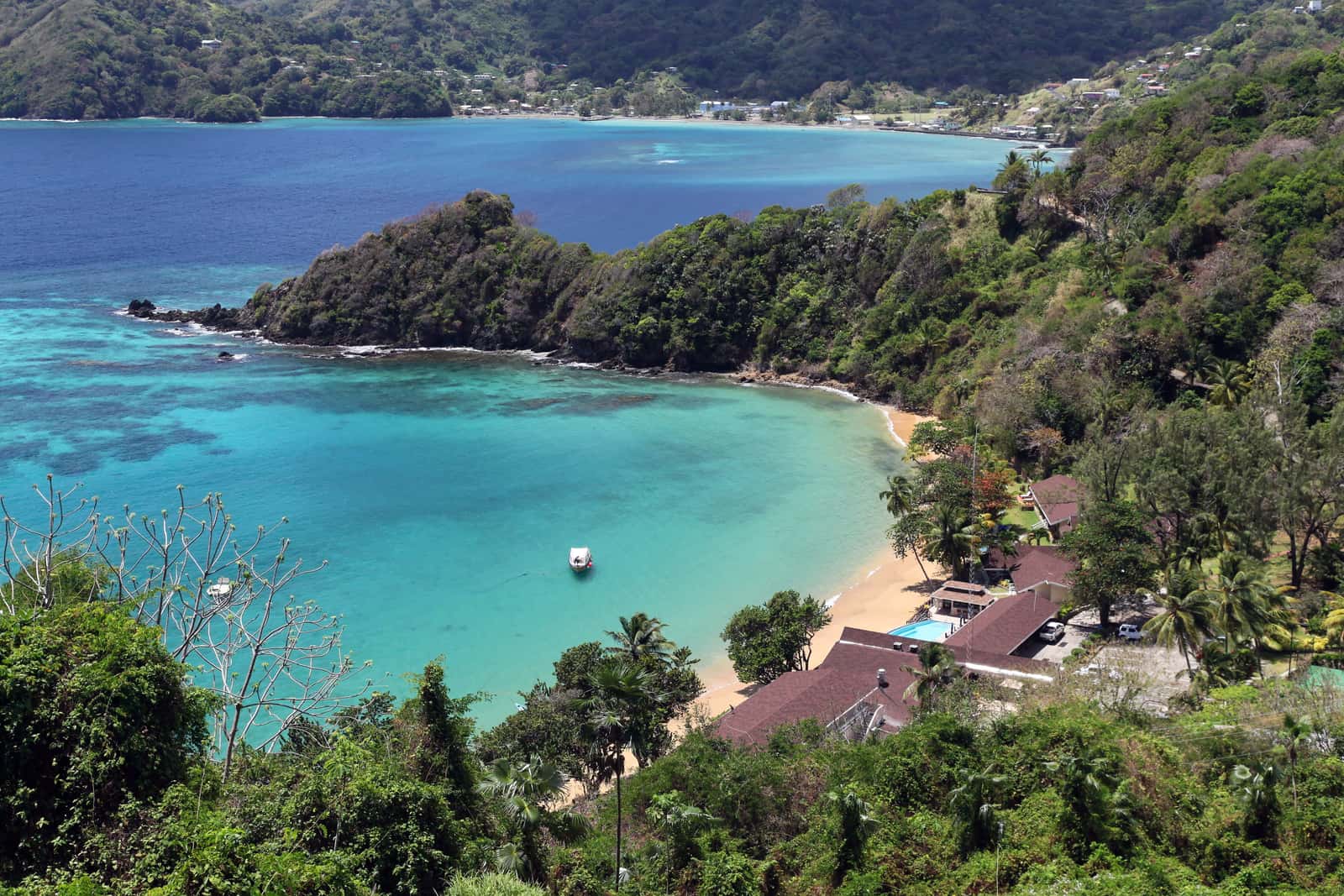
Red buoys in the shallow water. If you snorkel at Pigeon Point, you stay inside that line, because beyond it runs the channel the boats use to reach the reef. Further out lies Buccoo Reef. Walking on it is prohibited.
Tobago has two diving areas. In the south-west, on the Caribbean side, you find Buccoo Reef, the wall off Mount Irvine and a scuttled ferry. In the north-east, off Speyside on the Atlantic side, the reefs surround Goat Island and Little Tobago. Off Speyside you mostly dive in the current. That current brings the nutrients the reefs live on; according to discovertnt they arrive with the Guyana Current.
- Water temperature
- 24 to 28 °Ccoolest in January and February, according to discovertnt
- Visibility
- around 20 mup to 25 m in the dry season, according to one dive guide
- Current off Speyside
- about 2 knotsdrift diving area, according to one source
- Buccoo Reef
- protected since 1973Ramsar site since 2005
- Brain coral, Kelleston Drain
- about 3 m highand 5 m across, according to Guinness
Beaches with a reef on the doorstep
You don't need a boat to snorkel. On the west coast the reef at Arnos Vale Bay starts right at the sand. discovertnt calls it the best snorkelling in Tobago, Rough Guides counts it among the best on the island. The hotel above is closed and nobody keeps watch. Don't go in alone.
Along the north coast one bay follows another. Off Englishman's Bay a reef lies within reach of the beach, but it is only worth it in calm seas, and the bottom shelves steeply. In Castara you snorkel in Big Bay or in Little Bay, where in 2010 the tourism authority even held out the chance of mantas. discovertnt rates Parlatuvier as good, as long as you keep clear of boats and lines. And Pirate's Bay near Charlotteville offers some of the best snorkelling on the island, according to the tourism authority. You get there down a long flight of steps. Or a fisherman from Man o' War Bay takes you round by boat.
In the south-west you can hire snorkelling gear on the beach at Mount Irvine Bay. At the north end of Stonehaven Bay the snorkelling is fair to good, depending on the source. Pigeon Point and Store Bay work too. From Kilgwyn Bay on the south coast you can snorkel out as far as the dive site Flying Reef.
One rule holds almost everywhere. Snorkelling is only worth it in calm seas. And many bays, such as Arnos Vale Bay, Englishman's Bay or Parlatuvier, have no lifeguards. Which beach suits you otherwise is covered under beaches.
Buccoo Reef and Nylon Pool: by boat only
Buccoo Reef has been a marine protected area since 1973. According to English Wikipedia the reef complex covers about seven square kilometres, with five reef flats down to 25 metres. Since 2005 it has been a Ramsar site together with the neighbouring Bon Accord Lagoon.
Out at sea off Pigeon Point lies the Nylon Pool, a shallow sandbank. A tour itinerary gives its depth as no more than about four feet. Princess Margaret is said to have named it in 1962, because the water was as clear as nylon stockings. You can only get there by boat.
The glass-bottom boats leave from Store Bay and Pigeon Point, and some operators also start at the jetty in Buccoo. A trip takes about two hours. Under the island government's rules only licensed operators sell tickets, at booth no. 15 of the Store Bay beach facility and at the Blue Booth to the left of the waterfall in Pigeon Point Heritage Park. On booking portals trips cost around US$49 to 55 per adult (as of October 2026). Ask at the booths what they charge.
The Tobago House of Assembly restated the rules in April 2022. Walking on the reef without written permission is prohibited, and so is fishing of any kind. The rules also say:
- Trips only between 10 am and 5.30 pm, only in registered, insured boats with a permit.
- Boats travel only through the marked channel.
- No parties, no alcohol, no jet skis.
- Fish, birds and mangroves stay where they are, and the seabed is left undisturbed.
Visitors used to walk across the reef flats and turn over stones. A report by the World Resources Institute lists this, along with anchoring and groundings, among the damage to the reef. According to one guidebook, boat operators no longer advertise reef walks and tie up to mooring buoys.
Off Speyside: brain coral, mantas and current
Speyside lies in the north-east, on the Atlantic side. Goat Island and Little Tobago lie off the village, and between them are the reefs divers come for. What the village is like is covered under Speyside, swimming there under the beach at Speyside.
The best known site is Kelleston Drain, just south of Little Tobago. A brain coral grows there, about three metres high and five metres across. How it compares, three sources put differently. Guinness lists it as the largest brain coral colony of all. discovertnt writes of the largest living brain coral in the Caribbean, with some arguing it is the largest in the world. The Institute of Marine Affairs, as quoted in the Trinidad Express, calls it the largest of its kind in the Western Hemisphere. The 2024 bleaching hit it too.
On the edge of Goat Island lies Japanese Gardens, with vase sponges, damselfish and sea turtles. One travel company describes it as suitable for all levels. Just off Goat Island is Angel Reef, where glass-bottom boats also go. discovertnt also lists Kamikazee Cut and Black Jack Hole.
Mantas turn up in two places. Dive travel companies mention a cleaning station at Kelleston Drain. And at The Sisters, rock pinnacles about five kilometres off Bloody Bay in the north-west, discovertnt mentions mantas and hammerheads. On the season, the companies disagree. Some give March to July, with mating season in April and May. Others see the mantas reliably from March to August.
The Guyana Current brings nutrients from the Orinoco estuary, and with them plankton. That feeds the reefs but cuts visibility. One dive guide expects 20 metres on average and up to 25 in the dry season from January to May. Off Speyside you drift, and one source gives about two knots of current. For Divers Dream, discovertnt recommends experience because of the strong current. At London Bridge near St Giles Island, off the north-east tip, discovertnt mentions tarpon, turtles and sharks.
In the south-west: the Maverick wreck and the Mount Irvine wall
The Maverick was the first passenger ferry between Trinidad and Tobago, formerly called Scarlett Ibis. She was scuttled in April 1997. Today she is a dive site off Rocky Point on the Caribbean side. According to discovertnt the upper deck lies at 18 metres and the bottom at 33. deeperblue gives a maximum of 30 metres. Three sources disagree on her length: 230 feet says uncommoncaribbean, 168 feet scubadiving.com, 107 metres deeperblue. The sources recommend the wreck for experienced divers.
Shallower is the Mount Irvine Wall, about 15 metres deep according to scubadiving.com, where discovertnt shows a hawksbill turtle. To the south lies Flying Reef with large plate corals, nurse sharks and stingrays. Dive centres are concentrated around Crown Point, on the Caribbean coast near Mount Irvine and in Speyside.
How the reefs are doing after the hot years
Older descriptions of Tobago's reefs are too colourful. Major bleaching events struck in 1998, 2005 and 2010. After the 2010 event the reefs had lost about half their coral, says Anjani Ganase of the Institute of Marine Affairs (IMA). According to English Wikipedia, hard coral cover at Buccoo Reef fell from just over 25 per cent in 2010 to just over 16 per cent in 2012.
In 2023 the corals at Mount Irvine, Buccoo Reef and Flying Reef were bleached. The surface of the sea reached 31 degrees, and loggers in the shallows had recorded up to 34. 2024 was worse. At alert level 5, TTT and Cari-Bois reported more than 80 per cent bleached coral at Buccoo, Castara, Culloden and Mount Irvine. Some species bleached at 95 to 100 per cent. Slides from the IMA show the staghorn coral in the Buccoo protected area as completely dead. You can still snorkel and dive. Just expect paler reefs.
In early February 2024 the barge Gulfstream capsized off Cove on the south coast. Oil hit the coast between Scarborough and Sandy Point, including Canoe Bay, Kilgwyn, Petit Trou and Lambeau. The Caribbean side from Pigeon Point to Charlotteville and the Atlantic coast from Bacolet to Delaford were spared, the tourism agency said in March 2024, and that includes Buccoo Reef and Speyside. In February 2025 oil turned up again at Petit Trou. If you want to snorkel from Kilgwyn Bay to Flying Reef, ask locally whether the beach has reopened.
And one mix-up that comes up often. The Tobago Cays Marine Park is not off Tobago at all but in St Vincent and the Grenadines.
Before you get in the water
For divers there was a hyperbaric chamber at the hospital in Roxborough. According to the island government THA in February 2022, it treated up to three patients a day, one at a time; that same year it helped a diver from Barbados. Whether that still holds, your dive centre will know.
Our tipBefore your first dive, ask whether the chamber in Roxborough is in operation and what the dive centre does in an emergency. The answer also tells you a fair amount about the centre.
Currents run at the beaches too. Near Sandy Point next to Kilgwyn Bay, Rough Guides warns of a strong current on the right-hand side, and Bacolet Bay has occasional dangerous undertow. At Buccoo Reef: touch nothing, take nothing, never stand on the reef. What grows and nests on land, from the rainforest to the bird island of Little Tobago, is covered under nature.
Frequently asked questions about diving in Tobago
When can you see manta rays in Tobago?
Dive travel companies disagree: some give March to July, with mating season in April and May, others say mantas are seen reliably off Tobago from March to August. They are reported at the rocks called The Sisters off the north-west coast and at Kelleston Drain off Speyside.
Can beginners dive off Speyside?
In part. Off Speyside on Tobago's Atlantic side most dives are drift dives, and one source gives a current of about two knots. Japanese Gardens on the edge of Goat Island is described as suitable for all levels, while discovertnt recommends sites such as Divers Dream for experienced divers only.
What are the rules for boat trips to Buccoo Reef?
Under the Tobago House of Assembly rules of April 2022, only registered, insured boats with a permit may visit Buccoo Reef, during daytime hours only and through the marked channel. Walking on the reef, fishing of any kind, parties and alcohol are prohibited.
How warm is the water for diving in Tobago?
According to discovertnt the sea around Tobago is 24 degrees Celsius in January and February and up to 28 degrees in the warm season. A three-millimetre wetsuit is usually enough.
Is there a decompression chamber in Tobago?
According to the island government THA, there was a hyperbaric chamber at the hospital in Roxborough in 2022, treating one patient at a time. Ask your dive centre before your first dive whether it is in operation.